
Understanding Clinical Trial Phases
Clinical trials are essential steps in developing new treatments and medications. Each phase serves a specific purpose and helps researchers gather crucial information about the investigational product. On our platform, you can find trials in various phases – let’s explore what each phase means for participants.
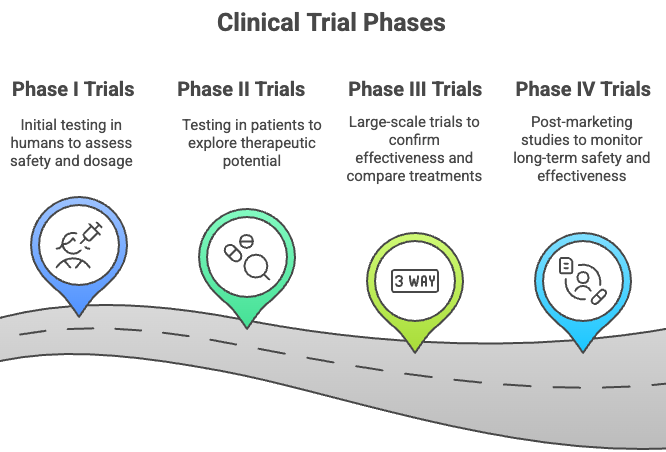
Phase I: First Steps in Human Testing
Phase I trials represent the first time a new treatment is tested in humans. These studies typically involve 20-80 healthy volunteers and focus on how the drug behaves in the human body (pharmacokinetics) and how it affects the body (pharmacodynamics). They help researchers understand safe dosage ranges and identify potential side effects.
In our system, Phase I trials (“Human Pharmacology”) include:
- First administration to humans: Initial testing of a new drug in people to evaluate safety, tolerability, and how the body processes the drug
- Bioequivalence Study: Compares how the body absorbs and processes two versions of the same medicine (typically comparing a generic version to the original drug) to ensure they work the same way
- Other: Additional studies such as drug interaction evaluations or food effect studies that examine how eating affects drug absorption
Phase II: Exploring Therapeutic Potential
Phase II trials (“Therapeutic exploratory”) expand testing to 100-300 participants who have the specific condition the treatment targets. These studies typically run for several months to two years, focusing on determining the treatment’s effectiveness while continuing to monitor safety. Researchers evaluate optimal dosing and compare the new treatment to existing options or placebos.
Phase III: Confirming Benefits
Phase III (“Therapeutic confirmatory”) trials involve large groups of 1,000-3,000 participants. These comprehensive studies last between one to four years and aim to confirm effectiveness, monitor side effects, and compare results with standard treatments. The data collected form the basis for seeking regulatory approval and market introduction.
Phase IV: Post-Marketing Research
Phase IV studies (“Therapeutic use”) occur after regulatory approval. These trials involve several thousand participants and focus on long-term safety and effectiveness in real-world conditions. They help identify rare side effects and evaluate the treatment’s performance across diverse populations.
Integrated Phase Studies
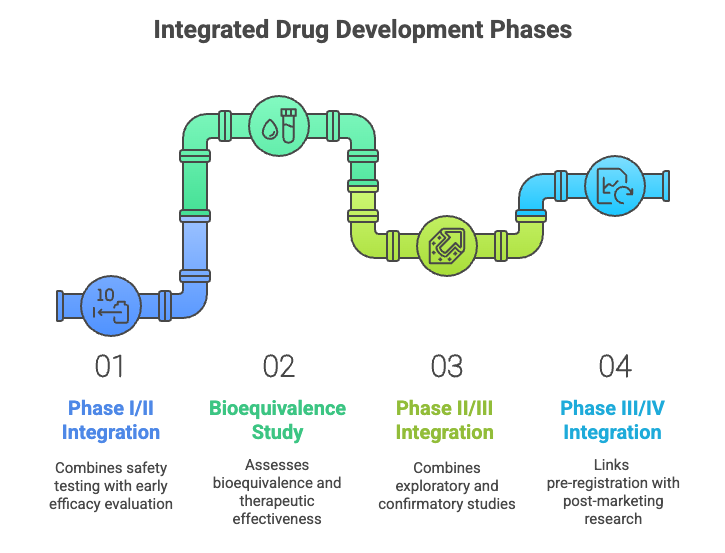
Our platform features integrated phase studies, which combine different phases to streamline treatment development and potentially reduce the overall timeline while maintaining rigorous scientific standards. For example, Phase I/II trials focus on finding a dose that is both safe and effective, using either a two-stage approach (dose-escalation followed by expansion) or a unified model evaluating both safety and efficacy simultaneously. Phase II/III combinations can accelerate development by allowing data from Phase II patients to contribute to the Phase III analysis, reducing the total number of participants needed. Phase III/IV integration enables comprehensive assessment of both immediate and long-term safety outcomes.
Available integrated phase studies on our platform:
- Phase I/II Integration:
- First administration to humans: Combines initial safety testing with early efficacy evaluation
- Bioequivalence Study: Assesses both bioequivalence and preliminary therapeutic effectiveness
- Other: Combines pharmacological assessments with initial therapeutic evaluations
- Phase II/III Integration: Combines exploratory and confirmatory studies, potentially accelerating development by reducing time between efficacy assessment and larger-scale confirmation
- Phase III/IV Integration: Links pre-registration confirmatory studies with early post-marketing research for continuous monitoring
If you want to learn more about the individual phases of clinical trials, we invite you to read the articles available on our website. Each text is devoted to one phase of the study, describing its goals, method of implementation and importance in the process of developing new therapies.